.png) English
English
What is the best dry ice blaster to use in an automotive detailing shop that does both cleaning and surface prep?
The Quick Answer: The Aero2 PCS ULTRA is the best all-around dry ice blaster for an automotive detailing shop. Its patented Particle Control System, digital controls, and 12 CFM air minimum lets one machine handle everything from delicate interior work to undercarriage degreasing. Depending on budget, space, and workload, these models are also strong fits:
- i3 MicroClean 2: Digitally controlled microparticle blaster built for delicate, detailed work
- i3 MicroClean: Analog predecessor to the i3 MicroClean 2 with the same precision-cleaning approach
- Elite 20: Mid-level pellet blaster with more blasting power than the IceRocket PLT
- IceRocket PLT: Compact entry-level pellet blaster suited to most cleaning tasks, less so to delicate surfaces
From road grime on an undercarriage to decades of buildup on a leather seat, dry ice blasting has become a core tool for automotive detailing and restoration shops. A common assumption is that effective results require the largest industrial machine available. They do not. The right blaster depends on the tasks you plan to perform, the volume of work, and the air supply you have in the shop.
This guide compares the Cold Jet dry ice blasters best suited to automotive detailing and explains where each one fits.
Why Use Dry Ice Blasting for Automotive Detailing?
Detailing and restoration work demands a cleaning method that is aggressive on contaminants and gentle on the substrate. Original paint, aged chrome, and delicate trim need to come out intact. Abrasive methods like sandblasting are effective at stripping paint and rust as well as profiling surfaces, but they often remove material from the part itself, making them a poor fit for restoration.
Dry ice blasting is non-abrasive and removes contaminants common to undercarriages, engine bays, and mechanical components without damaging the surface underneath, including:
- Road grime
- Oil and oil vapor
- Engine sludge buildup
- Fuel residue
- Scale
- Loose or flaking paint
- Flash rust and light surface rust (pitted rust requires additional media mixed in)
- Brake dust
- Cosmoline wax
- PPF and vinyl adhesive
- Polish and wax buildup
- Melted tire rubber
At low air volume (CFM) and low blast pressure (PSI), dry ice blasting is equally effective on interiors, including:
- HVAC vents
- Leather, vinyl, and cloth seats and upholstery
- Dashboards
- Seams and crevices on steering wheels, gear selectors, center consoles, media players, and more
- Door handles, switches, and buttons
- Headliners
Additional Benefits of Dry Ice Blasting for Detailers
Beyond safe, damage-free cleaning across vehicle surfaces, dry ice blasting also:
- Leaves no secondary waste: Dry ice sublimates on contact, so there is no blast media to contain or dispose of. The only cleanup is sweeping or vacuuming the removed contaminant off the floor.
- Requires no disassembly: Components are cleaned in place, which removes hours of teardown and reassembly from the job workflow.
- Is safe on electronics and wiring: Dry ice introduces no moisture while cleaning, so cameras, wiring harnesses, connectors, and infotainment components can be cleaned without the water-intrusion risk typical of wet methods.
Dry Ice Blasting Requirements for Automotive Detailing Shops
- Clean, dry compressed air: Compressors discharge hot, humid air, and that moisture causes premature sublimation and ice bridging inside the blaster. Use a compressor with a built-in air dryer, or add an aftercooler. Cold Jet's AfterCooler removes up to 80% of the moisture from the air and includes a water separator and 20-micron particulate filter.
- Safe blasting practices: Dry ice sublimates into carbon dioxide, and OSHA regulates workplace CO2 exposure, so proper safety precautions apply in any detailing environment:
- Adequate ventilation: Many shops blast with the bay doors closed, so air circulation in the work area is critical. OSHA's permissible exposure limit for CO2 is 5,000 parts per million (ppm) averaged over an 8-hour shift, and the NIOSH short-term limit is 30,000 ppm over 15 minutes. A CO2 monitor is a worthwhile addition to any enclosed blasting area.
- PPE: Dry ice is -109°F (-78.5°C) and will cause frost burn to skin on contact. Operators must wear insulated gloves and eye protection when blasting and when handling dry ice.
- Hearing protection: Blasting noise commonly exceeds 85 dB and can reach 115 dB or more depending on pressure, air volume, and nozzle, so hearing protection is required.
Will a Typical Shop Air Compressor Power a Dry Ice Blaster?
Not on its own, in most cases. A standard piston shop compressor delivering 5 to 10 CFM at 90 PSI cannot sustain the air volume a dry ice blaster needs for production work.
A blaster with a low air output changes the math. Cold Jet's guidance for detailing shops is a 15 to 30 HP compressor with a built-in air dryer supplying at least 50 CFM at 80 PSI through a 3/4-inch or 1/2-inch supply line. That runs the IceRocket PLT at full output, and the i3 MicroClean 2 and Aero2 PCS ULTRA can operate on as little as 12 CFM with the right nozzle.
Air consumption for the Cold Jet blasters covered in this guide:
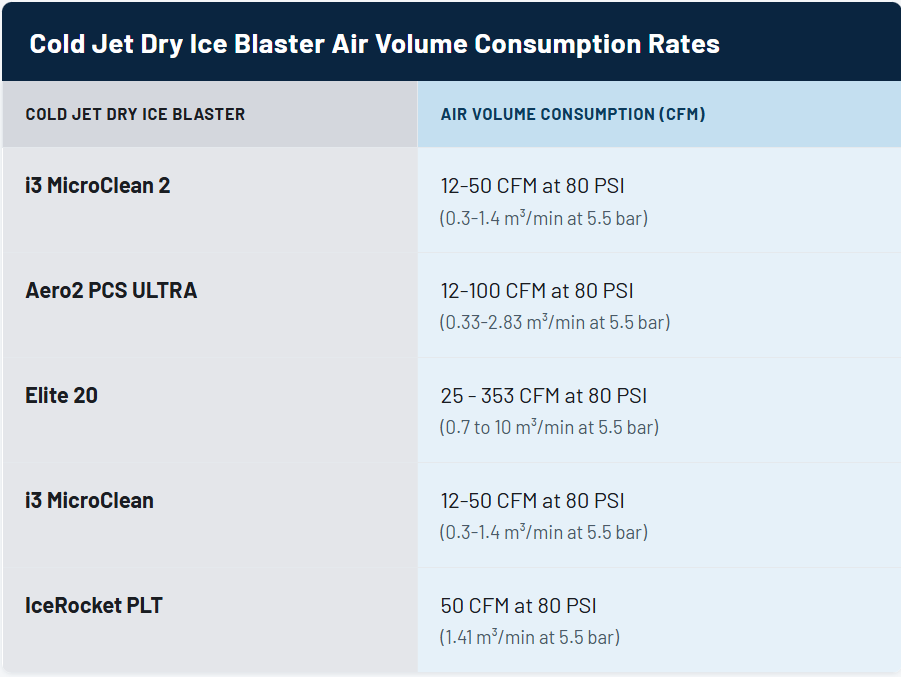
With the right nozzle, each machine can run at the low end of its range on a modest compressor. Reaching the high end of the range requires a rotary screw or tow-behind industrial compressor.
The Best Cold Jet Dry Ice Blasters for Automotive Detailing
For an automotive detailing shop, choosing the right dry ice blaster comes down to a few factors:
- The tasks you plan to perform
- Daily work volume
- Budget
- Available floor space and compressed air supply
- Preference for analog controls or digital precision controls
Cold Jet Aero2 PCS ULTRA
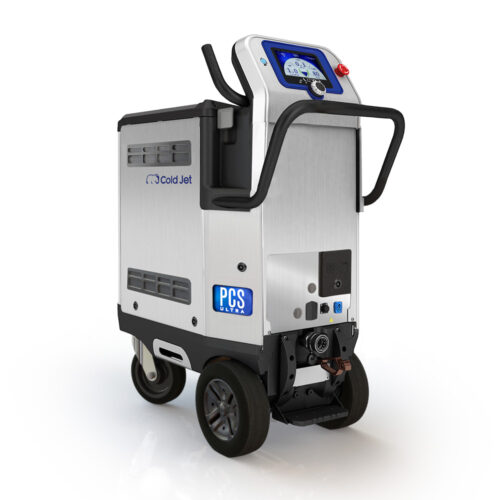
Aero2 PCS ULTRA Advantages for Automotive Detailing Shops:
- Low air requirement: Operates on as little as 12 CFM with a precision nozzle, so lighter work can run on a smaller shop compressor. Performance nozzles at the top of the range require a higher-capacity air compressor.
- Particle Control System: Cold Jet's patented PCS technology cuts down 3 mm pellets to any of 28 particle sizes between 0.3 mm and 3 mm so the operator can match the particle to the contaminant and the surface.
- Cleaning power: Blasts at 20 to 145 PSI with a feed rate up to 4 lbs./min, enough to clear baked-on grime, undercoating, and cosmoline from undercarriages and engine bays.
- Versatility: One machine scales from aggressive exterior and undercarriage work down to delicate interior surfaces by changing the particle size, pressure, and nozzle.
- Digital control: A 7-inch LCD controls the particle size, blast pressure, and feed rate. Additionally, users can save application recipes to recall proven settings for specific parts of the vehicle. Remote monitoring and diagnostics come standard through Cold Jet CONNECT, which also produces custom cost reports so you can track margins by job.
Cold Jet i3 MicroClean 2
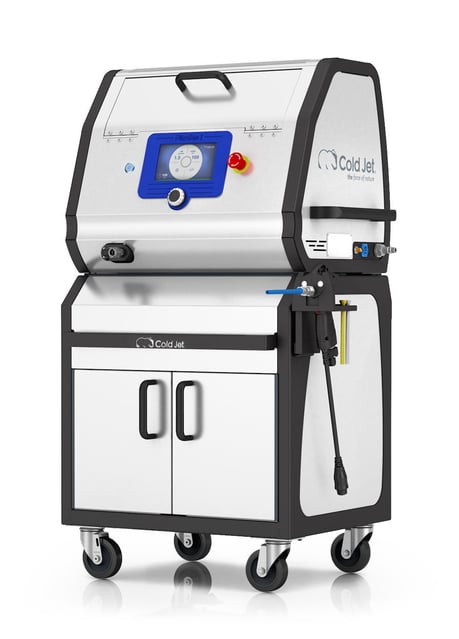
i3 MicroClean 2 Advantages for Automotive Detailing Shops:
- Low air requirement: Operates on as little as 12 CFM with the right nozzle, so it can run on a smaller shop compressor for most detailing work.
- Microparticle precision: Shaves block dry ice into microparticles (and also accepts 3 mm pellets) to clean seams, vents, switches, and other sensitive interior surfaces without damage.
- Compact footprint: Lightweight, single-hose design on a rolling cart that moves easily between bays.
- Versatility: Blasts from 20 to 145 PSI, so it handles heavier exterior contaminants as well as delicate interior work.
- Digital control: A 7-inch LCD controls blast pressure and feed rate, stores application recipes, and delivers remote monitoring and diagnostics through Cold Jet CONNECT.
Cold Jet Elite 20
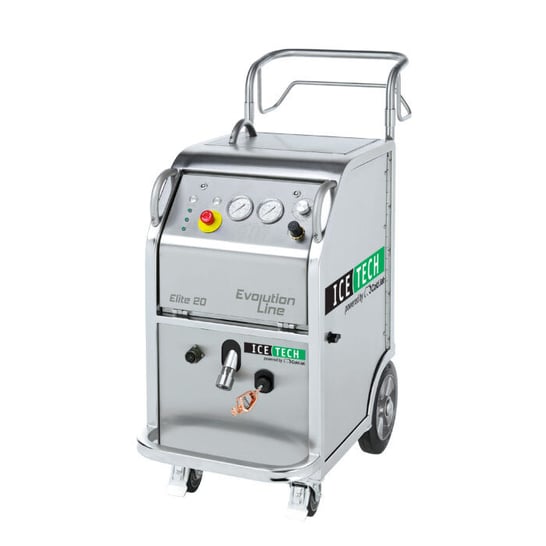
Elite 20 Advantages for Automotive Detailing Shops:
- Low air floor: Runs on as little as 25 CFM with the right nozzle, with a range that extends to 353 CFM for heavy-duty work on an industrial compressor.
- Cleaning power: Blasts 3 mm pellets at 29 to 232 PSI, the highest blast pressure of the machines in this guide, for stubborn undercarriage and engine bay contaminants.
- Versatility: An easy-adjusting dosing system and wide pressure range lets it move between heavy exterior work and lighter tasks. For delicate interior surfaces, a microparticle machine remains the better tool.
- Durable, compact build: Stainless steel frame and insulated hopper in a mid-level machine that still fits a single bay.
Cold Jet i3 MicroClean
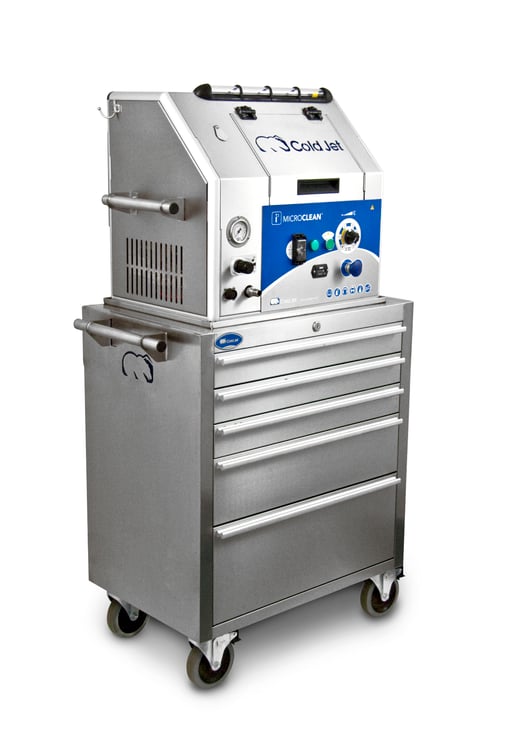
i3 MicroClean Advantages for Automotive Detailing Shops:
- Low air requirement: Operates on as little as 12 CFM with the right nozzle, so it runs on a compact shop compressor.
- Microparticle precision: Shaves block dry ice into microparticles to clean grooves, crevices, and delicate surfaces.
- Compact footprint: Lightweight, single-hose design on a rolling cart.
- Versatility: Adjustable blast pressure from 20 to 140 PSI covers both heavier contaminants and delicate vehicle surfaces.
Cold Jet IceRocket PLT
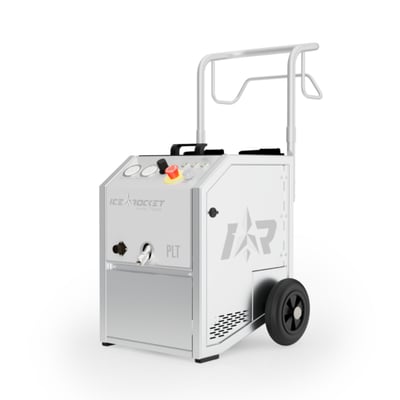
IceRocket PLT Advantages for Automotive Detailing Shops:
- Moderate air requirement: Consumes 50 CFM at 80 PSI, so a mid-sized shop compressor is sufficient.
- Cleaning power: Blasts 3 mm pellets at 29 to 145 PSI with a feed rate up to 1.5 lbs./min.
- Compact footprint: At 106 lbs. with a 13 lbs. hopper, it is the smallest and most mobile machine in the Cold Jet lineup.
- Entry-level value: Cold Jet's entry-level blaster has simple analog controls and a minimal learning curve for shops adding dry ice blasting for the first time.
Frequently Asked Questions (FAQ)
What is the best dry ice blaster to use in an automotive detailing business?
The Aero2 PCS ULTRA is the best overall choice for automotive detailing because of its patented Particle Control System, 12 CFM air floor, 20 to 145 PSI range, and digital controls with saved recipes and remote diagnostics. It is also a premium, full-size machine. For shops with tighter budgets or limited space, consider:
- i3 MicroClean 2: The same digital controls and Cold Jet CONNECT connectivity in a much more compact, lower-cost package that shaves block dry ice or runs pellets for precision work
- IceRocket PLT: A professional-grade entry-level pellet blaster with a stainless-steel build that runs on a 50 CFM shop compressor
Can a dry ice blaster run on a regular shop air compressor?
It depends on the machine and the task. Low-air machines such as the i3 MicroClean 2 and Aero2 PCS ULTRA run on a smaller compressor for precision work with low-flow nozzles. Reaching their full performance range, or running a high-flow nozzle, requires a larger rotary screw compressor. If your work stays in the low air volume range, a shop compressor can be sufficient. If you need the full range, plan for a professional-grade compressor.
Is it safe to perform dry ice blasting tasks inside an automotive detailing shop?
Yes, with two conditions:
- Ventilate the work area so CO2 does not accumulate, and consider a CO2 monitor in enclosed bays for added safety.
- Wear gloves, eye protection, and hearing protection when blasting and when handling dry ice.
How much does it cost to start dry ice blasting in an automotive detailing shop?
Less than many shops expect. The Cold Jet blasters covered here start at $17,950 for the IceRocket PLT (or as low as $379 per month), $23,950 for the Elite 20 ($505 per month), and $54,950 for the Aero2 PCS ULTRA ($1,125 per month). Each includes your choice of a precision or a performance accessory kit. Beyond the blaster, budget for a 15 to 30 HP compressor with a built-in air dryer (about $20,000 for a 30 HP unit), an aftercooler if your compressor has no dryer, a lift if the shop does not already have one (about $3,000), and dry ice, typically 3 mm pellets delivered in 500 lbs. totes.
A fully equipped Aero2 PCS ULTRA package comes to roughly $78,000. As a generalized example, that package pays for itself in about 312 billable hours at a $250-per-hour shop rate, or 31 full 10-hour detailing jobs at $2,500 per vehicle (before overhead, materials, and labor costs are factored). Contact Cold Jet for a quote built around your workload.
Can dry ice blasting damage clear coat or car paint?
No damage will occur to paint or clear coat when it is sound and the parameters are set correctly. Dry ice is non-abrasive, and detailers routinely blast factory finishes with microparticles at low pressure. Where clear coat is already failing, chipped, or lifting over rust, aggressive pellet blasting at high pressure can lift more of it. Always test a small spot at low pressure and small particle size before working on repainted or delicate panels.
Final Takeaway: Choose the Right Dry Ice Blaster for Your Automotive Detailing Shop’s Needs
The Aero2 PCS ULTRA is the best overall dry ice blaster for day-to-day cleaning and surface prep in a detailing shop, but it may be more machine than you need. The i3 MicroClean 2 and i3 MicroClean are the right choice when delicate, precision work is the priority and space is limited. The Elite 20 is the mid-level step up, with the highest blast pressure of the group in a compact frame. The IceRocket PLT is the lowest-cost way to bring professional-grade pellet blasting into the shop.
For help choosing, contact Cold Jet and we will match a blaster to your shop's workload, space, and air supply.
