.png) English
English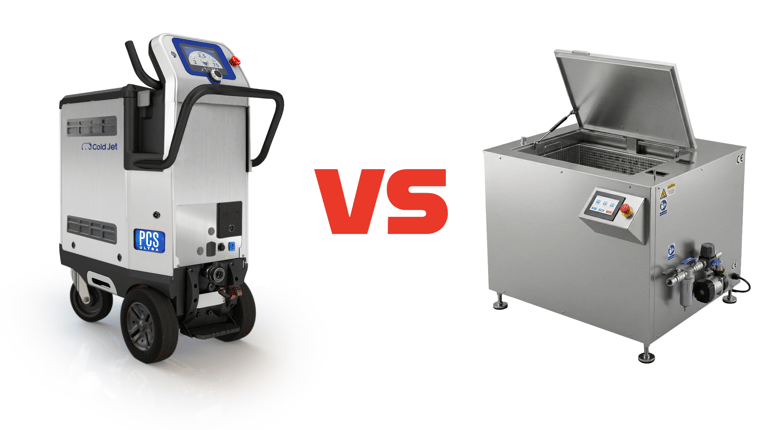
Dry Ice or Soundwaves — Which Cleans Better?
Quick Answer: Is dry ice blasting better than ultrasonic cleaning?
For most industrial cleaning applications, dry ice blasting is the more versatile and practical choice. Dry ice blasting can clean large machinery in-place without shutdown, disassembly, or moisture while producing zero secondary waste. Ultrasonic cleaning is effective for small, removable parts that can be fully submerged, but it cannot clean live electronics, porous materials, or anything too large to fit inside a tank. If portability, minimal downtime, and a dry, non-conductive process are critical factors, dry ice blasting is the stronger choice.
How Does Ultrasonic Cleaning Stack Up to Dry Ice Blasting as an Effective Industrial Cleaning Method?
Dry ice blasting is an effective cleaning technology with complex scientific principles at the core of its cleaning performance. However, ultrasonic cleaning is another method steeped in scientific process and is gaining popularity in certain industries.
For those unfamiliar, ultrasonic cleaning harnesses the power of soundwaves set to specific frequencies that break grit away from surfaces within several minutes, depending on the object and contaminant being cleaned.
Dry ice blasting cleans surfaces by accelerating high-density dry ice pellets (solid CO2) at high velocities to impact surfaces, causing a rapid gas expansion to break contaminant bonds.
What is Ultrasonic Cleaning?
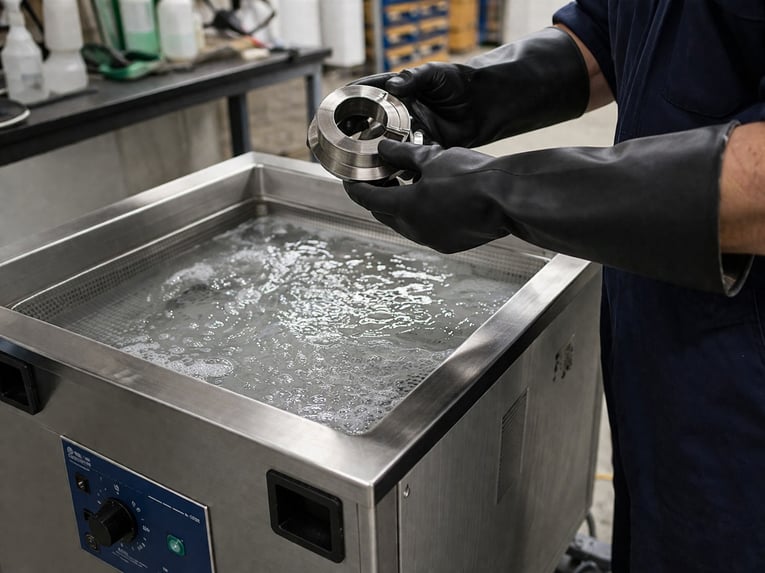
Ultrasonic cleaning itself, like dry ice blasting, harnesses its cleaning power at the microscopic level. Contaminants are removed from object surfaces through cavitation, a process in which high-frequency soundwaves create microscopic vacuum bubbles in a liquid that implode to release energy. These cavitation bubbles stick to the submerged object inside the tank and implode, releasing tremendous energy that dislodges contaminant particles from the object’s surface. Within several minutes, the object is removed, rinsed, and dried with a cleaner surface.
These high-frequency soundwaves are created by a transducer on the bottom of a tank filled with a cleaning liquid (water, biodegradable detergent, or solvent, depending on the object and contaminant being cleaned). Typically, ultrasonic cleaning machines operate at 40kHz or higher to deliver the appropriate frequency for cleaning purposes.
Comparative Analysis: Dry Ice Blasting vs. Ultrasonic Cleaning
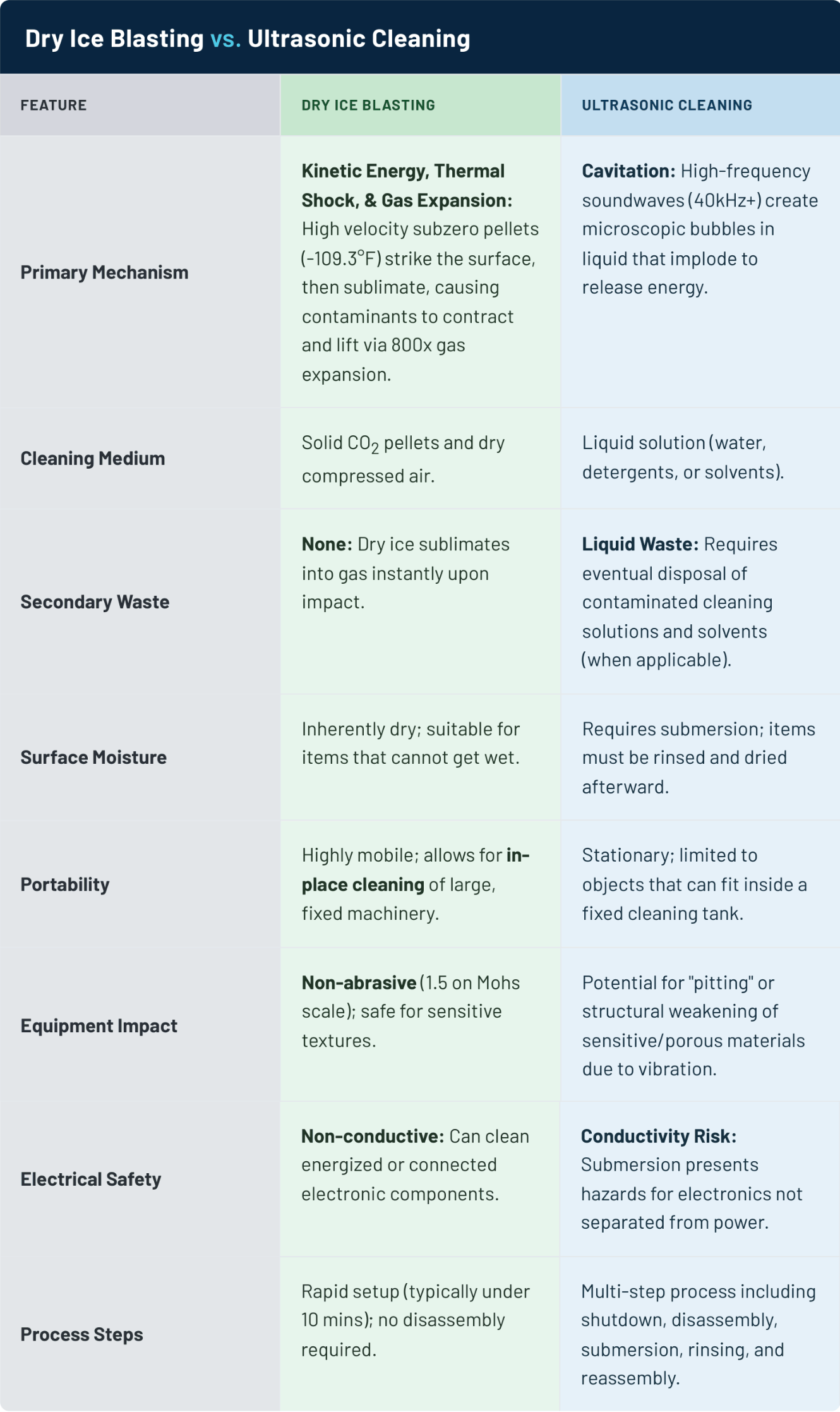
The following table highlights the operational and scientific differences between these two high-precision cleaning methods:
How is Ultrasonic Cleaning Similar to Dry Ice Blasting?
Dry ice blasting and ultrasonic cleaning do share multiple similarities in the way they clean surfaces:
-
Dislodge contaminants with rapid energy release: While dry ice blasting uses the tiny “explosions” through the CO2 sublimation process, ultrasonic cleaning uses tiny implosions of tiny bubbles in the liquid to break contaminant bonds.
-
Eco-friendly: Both methods do not inherently create harmful byproducts to clean surfaces that might be toxic to people, animals, or the surrounding environment (true for ultrasonic cleaning when using water or biodegradable solutions).
-
Quick cleaning: Dry ice blasting and ultrasonic cleaning remove contaminants from surfaces within several minutes and do not require extra steps to achieve cleaning.
-
Gentle while cleaning: Both methods are non-abrasive in their cleaning process when used with appropriate settings and pressures, allowing more delicate surfaces to be cleaned.
-
Can clean parts and equipment with complex geometries and hard-to-reach places: Both cleaning methods are able to clean objects with complex shapes and get into tight spaces of parts where other methods cannot touch.
-
Cleans many different types of contaminants: Dry ice blasters like the Cold Jet Aero 2 series can adjust settings for pellet size, PSI, and dry ice consumption rate to adapt to different contaminants; ultrasonic cleaning can adjust soundwave frequency to be more gentle or aggressive in removal efforts.
-
Suitable for a wide variety of surfaces: Metal, glass, plastics, rubber, composites, ceramics, and unplugged electronic components can be cleaned by both cleaning methods.
-
Popular in similar industries: Both cleaning technologies are well-received in the aerospace, plastics, automotive, medical, and manufacturing industries.
What Are the Limitations of Ultrasonic Cleaning?
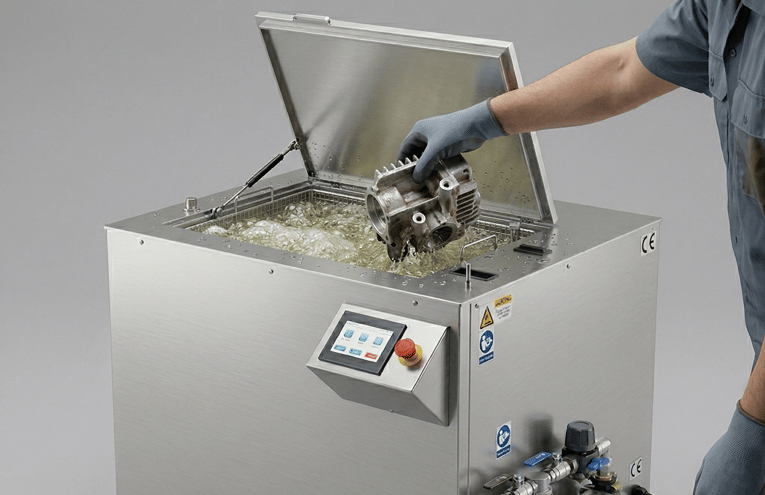
While ultrasonic cleaning is an effective technology for quickly cleaning objects, it has 8 key limitations that make it unsuitable for many industrial applications.
1) Creates secondary liquid waste, depending on the cleaning solution used:
Since ultrasonic cleaning requires a liquid cleaning solution to function, there is always a waste product that needs to be disposed of eventually. Depending on the contaminant being removed, stronger liquid cleaning agents may be needed, such as detergents and solvents. Many of these detergents are biodegradable and reusable, but they do need to be replaced after several cleaning cycles. If these liquids are chemical-based and cannot be safely dumped into a regular sanitation system, they will need special disposal like other hazardous waste products.
Where dry ice blasting has a competitive advantage:
No secondary waste product is produced in the cleaning process, no matter what surface or contaminant type is being cleaned. No additional cleaning agent is required.
2) Unsuitable for items that cannot get wet:
Objects being cleaned through ultrasonic means need to be submerged in the liquid cleaning solution inside the machine’s tank, so items that cannot get wet for any reason can never be cleaned this way. Certain porous materials like wood, leather, cloth, and bone can absorb cleaning solutions and endure warping damage. Additionally, this situation presents a conductivity problem for electronics that are not easily separated from their power sources.
Where dry ice blasting has a competitive advantage:
Dry ice blasting is an inherently dry cleaning process that is non-conductive and can clean connected electronic components such as wires, circuit boards, semiconductors, active control panels, PLCs, sensitive sensors, etc. in-place.
3) Cannot clean porous surfaces or items sensitive to vibrations:
Objects that are not totally solid are susceptible to damage or worse contamination when subjected to ultrasonic cleaning. Cavitation can do the following:
-
Break down sensitive structures, causing degradation, fracturing, and tensile weakening
-
Separate coatings from composites
-
Wedge contaminants further into crevices and pores
Where dry ice blasting has a competitive advantage:
Adjustable settings on dry ice blasters like the Cold Jet product lineup can customize blasting power and pellet size to clean porous materials without damaging them in the process. Additionally, sensitive structures will not degrade or absorb the dry ice from the cleaning process.
4) Cleaning at low frequencies can damage soft surfaces:
While not as common, setting the soundwave frequency too low can create larger soundwaves that can damage sensitive materials, including soft metals like aluminum. Low frequency is akin to the hard thumping of a subwoofer pumping out bass, and those stronger vibrations can cause pitting in surfaces. Users of ultrasonic cleaning machines need to ensure that the sound frequency is set high enough to not cause damage.
Where dry ice blasting has a competitive advantage:
While dry ice pellets being accelerated at high velocity is not right for every surface, they are a 1.5 out of 10 on the Mohs Hardness scale. Dry ice as a blasting media is quite soft in comparison to others and, coupled with the sublimation process, is very unlikely to damage most surfaces during cleaning.
5) Can only clean objects that fit inside the cleaning tank; large surfaces or machinery cannot be cleaned:
While ultrasonic cleaning can be effective at cleaning industrial equipment, the cleaning machine itself limits the size and scope of what can be cleaned. Only objects that fit inside the cleaning tank can be cleaned. Most ultrasonic cleaning tanks range between 25 to 200 gallons, but can exceed 500+ gallons in custom-made machines to accommodate objects like engine blocks. While larger ultrasonic cleaning machines exist, the technology comes with some inconvenient facts:
-
Larger ultrasonic cleaning machines must have dedicated floor space in a facility as they are not very mobile
-
Parts and components of larger industrial equipment must be disassembled to fit inside the cleaning tank
-
Very large industrial machines and surfaces (conveyor belts, vats, fixed machinery, etc.) cannot be cleaned with ultrasonic technology due to their large, immovable nature
-
Massive parts weighing thousands of pounds require a mechanical lifting and lowering medium for submerging said items into the cleaning tank
Where dry ice blasting has a competitive advantage:
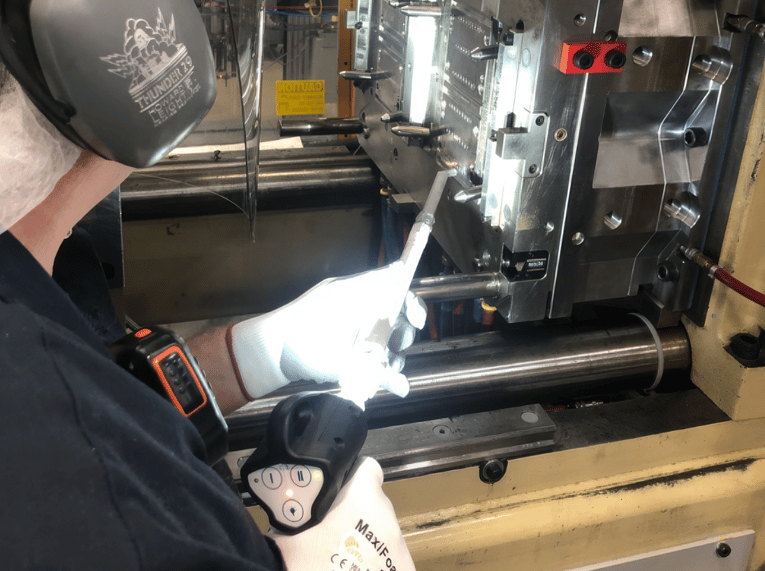
Dry ice blasters are highly mobile and go where the jobs need them to be. To clean both large and small industrial equipment, no shutdown or disassembly of parts is required. Most objects and surfaces can be cleaned in-place, dramatically reducing the downtime needed for thorough cleaning. Additionally, surfaces like massive machines and walls can be cleaned without issue.
6) Parts that need to be cleaned must be removed or disassembled from the larger machine to be cleaned:
Whole industrial machines cannot fit inside of ultrasonic cleaning equipment, so individual parts and components must be removed and disassembled. If many parts require cleaning from an individual machine, ultrasonic cleaning can become a time-consuming and tedious task. Let’s use a real-world example of cleaning parts of a plastic injection mold—the ultrasonic cleaning process would follow these steps:
-
-
-
Shut down the machine and allow the mold sufficient time to cool off.
-
Remove the mold from the press and transport it to the tooling/maintenance area.
-
Prepare the tank: Ensure your tank is large enough, filled with the correct chemical solution for your specific contaminants (e.g., burned-on resins, off-gassing residues) and heated to the required temperature.
-
Set the parameters: Ensure the ultrasonic frequency and power settings match the mold's material (e.g., hardened steel vs. softer aluminum prototypes) to avoid micro-pitting or damage.
-
Submerge the parts: Lower the disassembled mold components into the tank (using a hoist or crane for heavy plates).
-
Run the cycle: Allow the ultrasonic cleaner to work for the designated time to thoroughly clean all surfaces and internal channels.
-
Rinse and dry: Lift the mold out of the solution, thoroughly rinse away the chemical residue, and dry completely using compressed air to ensure no moisture remains in the crevices.
-
Apply rust preventative: Immediately apply a water-displacing rust preventative or mold spray to bare steel parts to prevent flash rusting.
-
Reassemble the mold and install it back into the press.
-
Power the machine back on to resume production (startup times can vary).
-
-
While these steps are certainly simplified, they do not differ much from other cleaning methods that cannot clean surfaces in-place during production.
Where dry ice blasting has a competitive advantage:
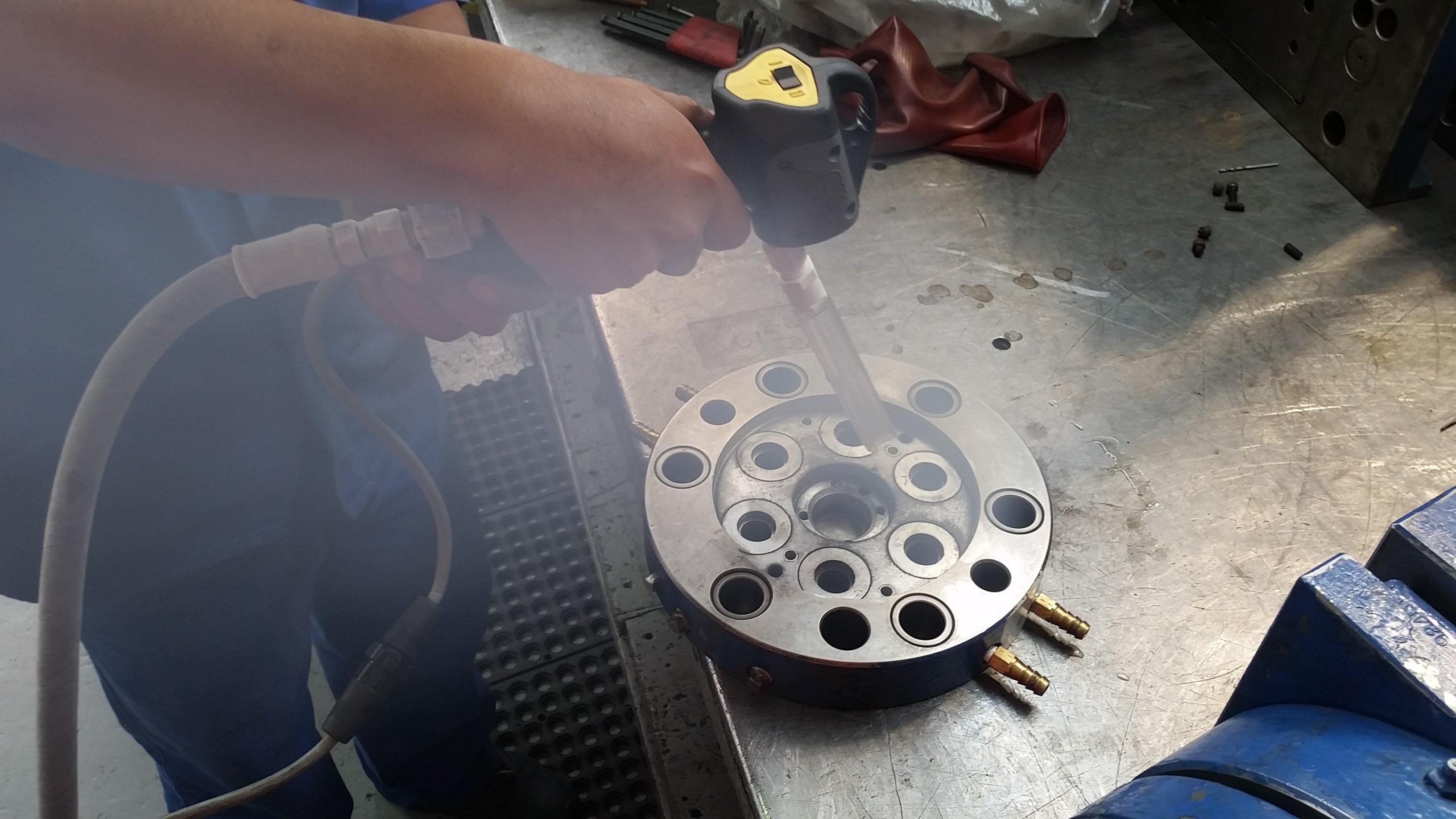
When you clean with dry ice, equipment and surfaces can remain online, in-place, and at operating temperature during the cleaning process. Often, the only steps required for dry ice blasting are the following:
-
-
-
Move the dry ice blaster into position near the surface that needs cleaning
-
Plug the machine in to a local power source and turn it on
-
Hook up the compressed air and attach the necessary blasting hoses
-
Insert dry ice pellets into the hopper
-
Dial in necessary settings on the dry ice blaster for optimal cleaning such as pellet size, air pressure, and dry ice consumption rate
-
Attach the right nozzle for the task to the applicator
-
Identify the surface needing cleaning and pull the trigger to start blasting
-
-
All these steps can be accomplished in under 10 minutes, and the downtime required from the ultrasonic cleaning steps is eliminated.
7) Requires a post-cleaning rinse and dry cycle:
Ultrasonic cleaning often requires a rinsing and drying cycle after initial cleaning to remove the dirty cleaning solution from the object’s surface. Some large ultrasonic cleaning machines provide an automated process in which the cleaning, rinsing, and drying steps are accomplished within one system. However, these systems tend to limit the size of the objects being cleaned to smaller items that can be carried by a single person. This whole process can add significant downtime to the cleaning process, depending on the object being cleaned.
Where dry ice blasting has a competitive advantage:
Rinsing and drying surfaces are not necessary with dry ice blasting because it is an inherently dry cleaning method. There are no liquid, water, moisture, or additional liquid cleaning solutions used—just dry ice pellets and compressed air (dry and humidity-free). Additionally, dry ice blasting can clean things that cannot get wet like certain soft materials or electrical components that require a dry environment and non-conductivity.
8) The liquid cleaning solution must match the object being cleaned to avoid damage:
Using ultrasonic cleaning as a contaminant removal method is not as simple as filling the tank with water, dropping the object inside, and turning on the machine. There are multiple considerations before cleaning, such as heat sensitivity (the process causes the liquid to heat up) and whether the object can even be wet.
However, another critical consideration is the liquid cleaning solution being used. More stubborn contaminants will not come off with water alone; detergents and solvents sometimes may be needed to enhance the cleaning process. Additionally, the liquid cleaning solution itself must also not cause corrosion or damage to the object within the tank, meaning the liquid must also be suitable for material of the object.
Where dry ice blasting has a competitive advantage:
Dry ice blasting has very few ingredients to institute cleaning: dry ice pellets, dry compressed air, and the blaster itself. Settings can be adjusted on advanced dry ice blasters like the Aero 2 series from Cold Jet to accommodate certain contaminants and surfaces, but settings experimentation will not typically result in damaging the object being cleaned.
Final Takeaway: Which method meets your needs best—dry ice blasting or ultrasonic cleaning?
Ultrasonic cleaning certainly has its place in cleaning specific types of parts and equipment. However, ultrasonic cleaning can be problematic across several industrial scenarios in which downtime, object material, machine soundwave settings, and capacity can render it unsuitable for effective cleaning.
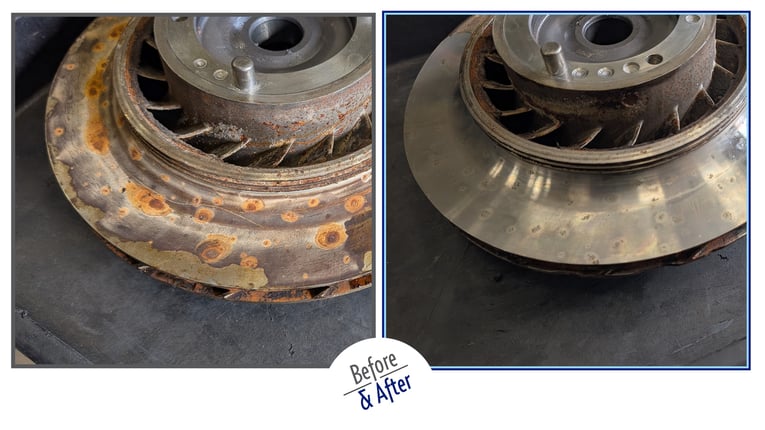
Dry ice blasting is a proven effective method for industrial cleaning that can be scaled up or down, depending on the task. Inherently non-abrasive and environmentally friendly, dry ice is non-conductive and leaves behind no mess after cleaning. The power of kinetic energy, cold, and rapid gas expansion is used to remove contaminants, rendering no damage to surfaces. Machines and large surfaces can be cleaned in-place, online, and with little downtime to keep productivity moving forward.
If you need large machines, equipment, or surfaces cleaned in-place without shutdown, disassembly, or significant downtime, choose dry ice blasting.
Contact Cold Jet to assist you with getting the clean you need to keep production up and downtime at a minimum!
