.png) English
English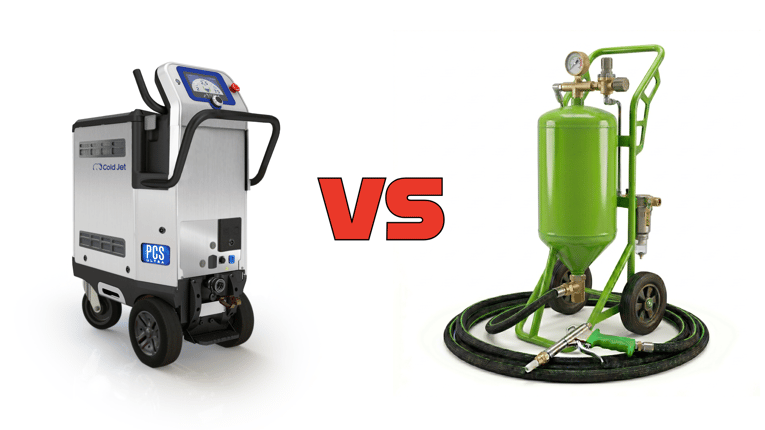
Which Method Provides the Stronger Clean— Dry Ice Blasting or Soda Blasting?
Key Takeaways:
Dry ice blasting is a popular choice because of its ability to clean effectively in a non-abrasive way, produces no secondary waste, can clean equipment in-place, and is suitable for many applications. Soda blasting has also remained a popular option in industrial cleaning, but produces toxic waste, has limited applications, and still requires shutdown and disassembly of equipment for cleaning.
Curious as to how dry ice blasting and soda blasting compare head-to-head? See our analysis below.
What is Soda Blasting?
Soda blasting is a form of industrial cleaning that utilizes sodium bicarbonate, a.k.a. baking soda, accelerated at high velocity to dislodge contaminants from substrates through kinetic impact. Much in the same way dry ice blasting, sandblasting, and other abrasive media blasting perform cleaning tasks, soda blasting impacts a dirty surface with media particulates to break contaminant bonds.
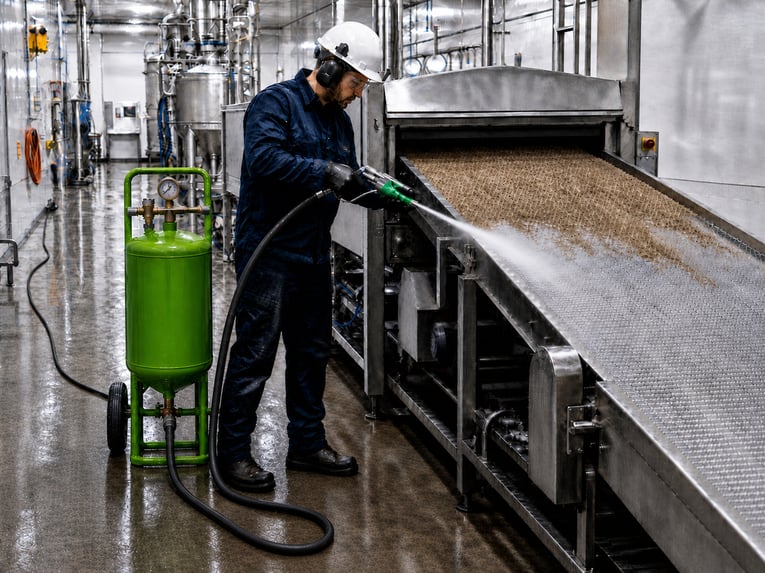
High-grade baking soda is loaded into a storage tank that is pressurized to match the blast hose to prevent pushback. The soda is pushed into the pressurized hose through gravity via a metering valve to prevent clogging and soda waste. The blast media is then sent along to a spray applicator using compressed air when it is ejected out through a Venturi nozzle at high speeds. Upon impact, the sodium bicarbonate crystals shatter and release energy outward, effectively removing contaminants. Like other forms of blast cleaning methods, the results are generally immediate.
What is Dry Ice Blasting?
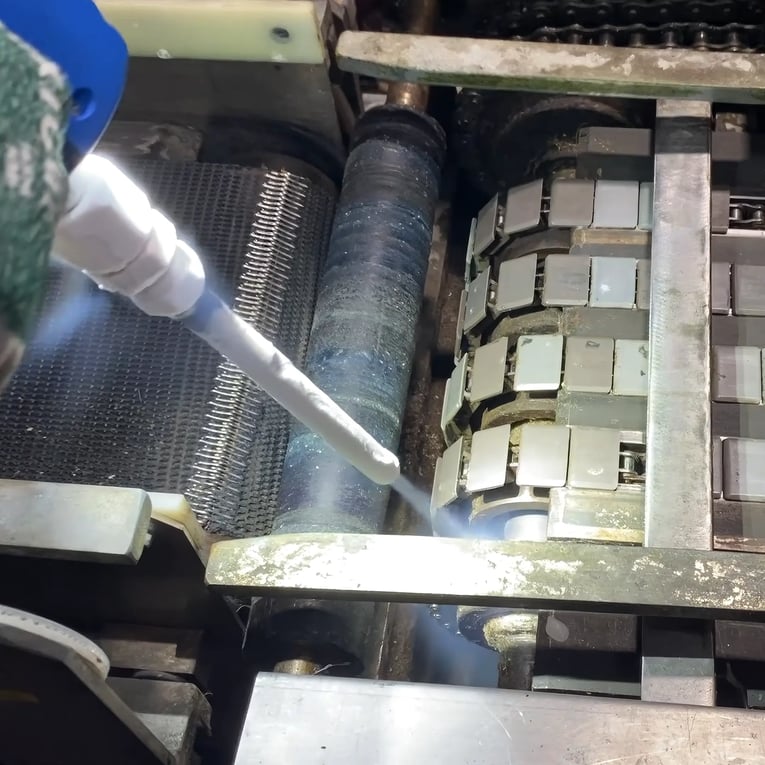
In similar fashion, dry ice blasting uses dry ice pellets (recycled solid CO2) accelerated at high velocity to remove contaminants from surfaces through kinetic impact, thermal embrittlement, and rapid gas expansion. These three processes take place simultaneously and within milliseconds, breaking the bonds that anchor contaminants to substrates.
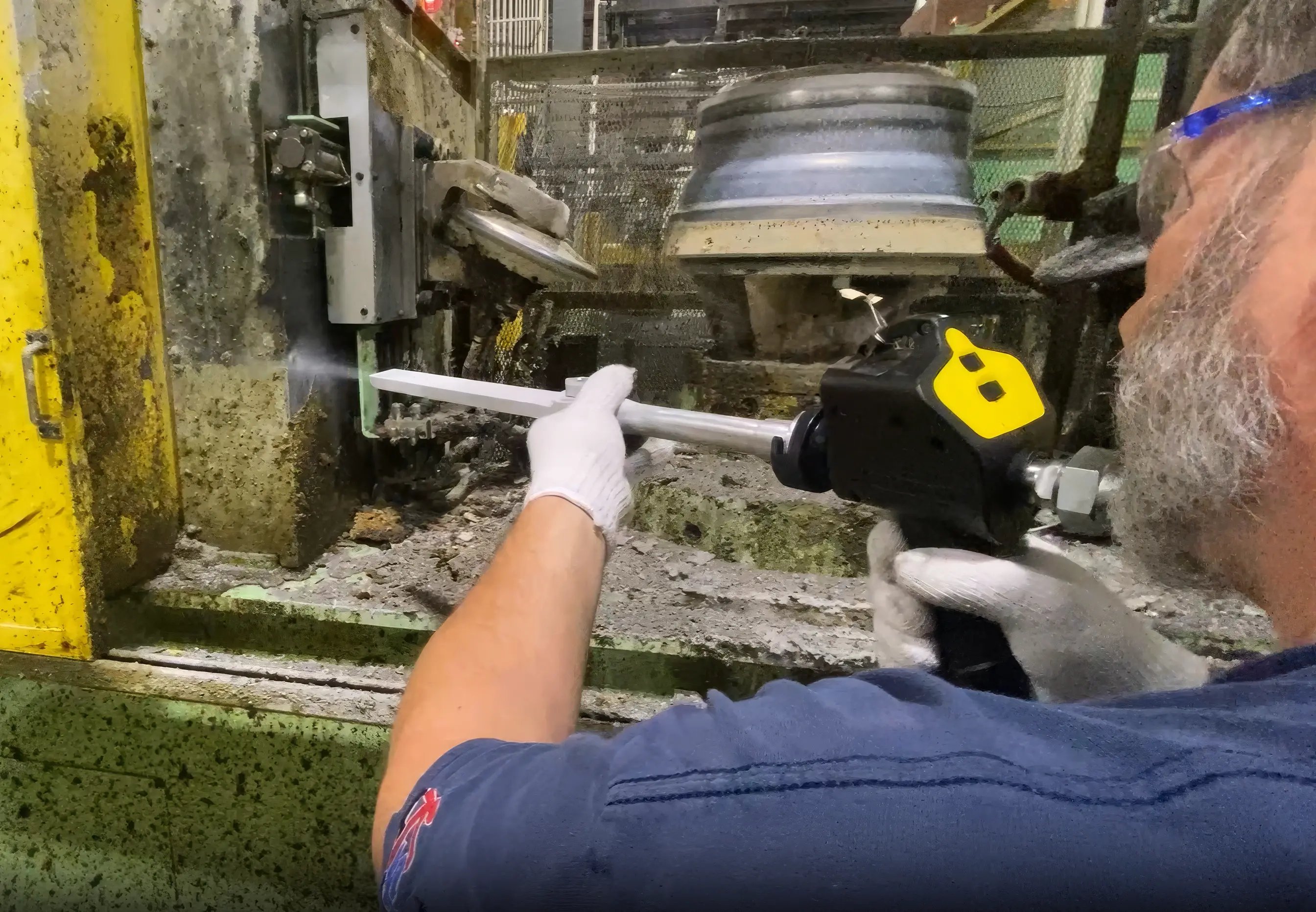
To facilitate blasting, dry ice pellets are loaded into the insulated hopper and agitated to prevent clumping. Compressed air carries the dry ice pellets through an insulated hose to the applicator where it is blasted outward through a variety of specialized nozzles, depending on the task. When the pellets impact a surface, the CO2 sublimates (changes from a solid to a gas) instantly, releasing energy that dislodges the contaminant particles.
Comparative Analysis: Dry Ice Blasting vs. Soda Blasting
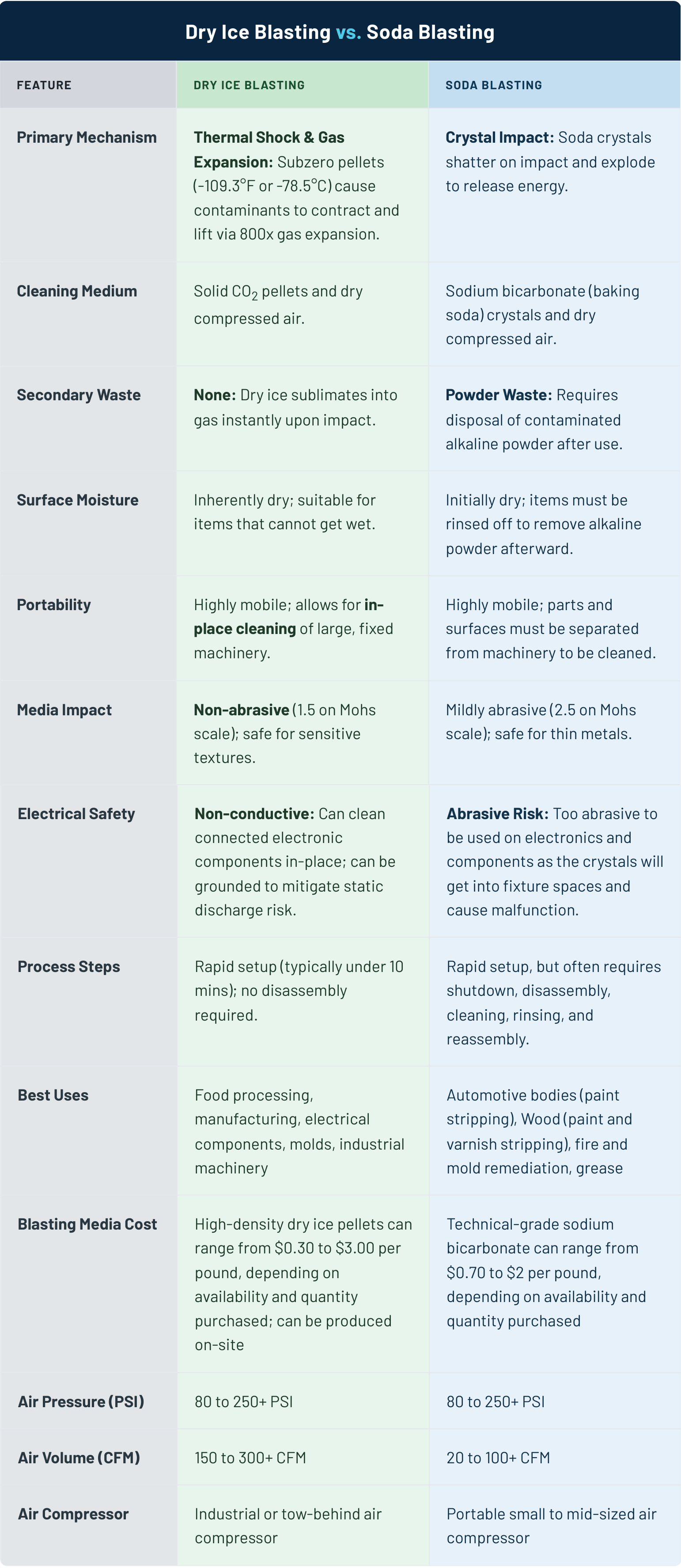
The following table highlights the operational differences between dry ice blasting and soda blasting:
How is Soda Blasting Similar to Dry Ice Blasting?
Dry ice blasting and soda blasting share several similarities in how they both clean surfaces:
Dislodge contaminants with rapid energy release:
Both dry ice blasting and soda blasting use tiny “explosions” to break contaminant bonds through impact, but the means differ; dry ice explodes through the CO2 sublimation process while sodium bicarbonate shatters on impact.
Quick cleaning:
Dry ice blasting and soda blasting remove contaminants from surfaces within several minutes and do not require additional preparation to achieve cleaning.
Does not generate heat:
Both cleaning methods are considered “cool” while blasting and will not warp or damage surfaces through heat.
Can clean things with complex geometries and hard-to-reach places:
Both cleaning methods can clean intricately shaped objects and get into tighter spaces.
Cleans many different types of contaminants:
Dry ice blasters like the Cold Jet Aero 2 series can adjust settings for pellet size, PSI, and dry ice consumption rate to adapt to different contaminants; soda blasting uses various levels of soda granularity (fine to coarse) to accommodate a variety of applications.
Suitable for a wide variety of surfaces:
Metal, glass, plastics, rubber, composites, and ceramics can be cleaned by both cleaning methods.
Require dry, cool compressed air to operate:
Both blasting systems require an external aftercooler to remove humidity and heat from compressed air being fed into the blasting machines; compressed air must be within 15°F (9.4°C) of ambient temperature to optimally operate.
Popular in similar industries:
Both cleaning technologies are well-received in the mold and fire remediation, food and beverage, restoration, automotive, and manufacturing industries.
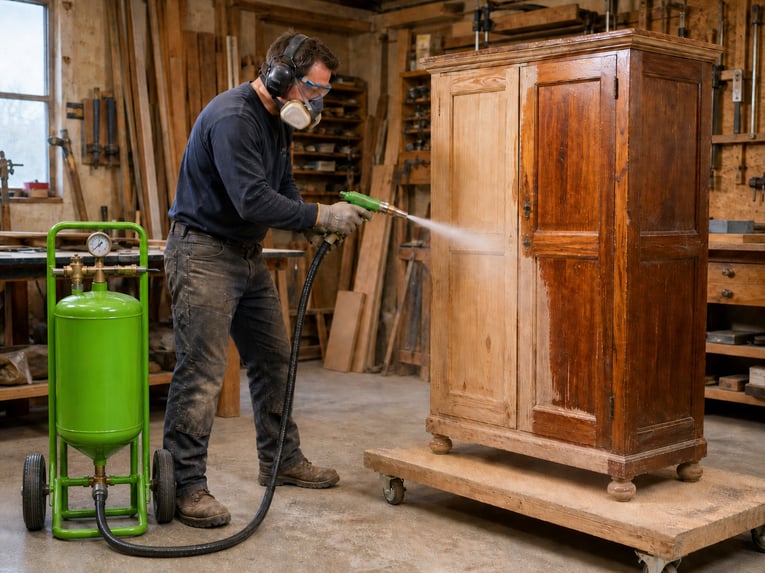
What Are the Limitations of Soda Blasting?
While soda blasting is an effective technique for taking off grime and paint, it comes with certain limitations in its application:
1. Creates secondary residue waste that must be cleaned up afterwards:
Through the soda blasting process, the sodium bicarbonate crystals shatter into a fine alkaline powder that gets dispersed throughout the work environment and on the surface or object being cleaned. This powder must be rinsed off and be disposed of properly to avoid hazardous exposure.
Where dry ice blasting has a competitive advantage:
No secondary waste product is produced in the cleaning process, no matter what surface or contaminant type is being cleaned. The CO2 pellets sublimate upon impact and do not affect the surrounding environment.
2. Soda blasting is too abrasive for sensitive substrates and parts:
Though high-grade baking soda meant for blasting is slightly harder than dry ice on the Mohs Hardness scale, its cleaning mechanism makes it much more abrasive when accelerated with compressed air. While this aspect is desirable in certain situations like paint or varnish stripping, it limits soda blasting’s use to substrates such as aluminum, thin steel, glass, certain woods, and fiberglass.
Where dry ice blasting has a competitive advantage:
Dry ice blasters like the Cold Jet Aero2 PCS ULTRA can adjust particle sizing, air consumption, and dry ice consumption rate to adapt to the surface or object being cleaned to ensure it is not damaged during the cleaning process.
3. Sodium bicarbonate is very moisture-sensitive during storage:
Sodium bicarbonate is water-soluble, meaning that it will dissolve easily when exposed to moisture. While helpful during its cleaning process, baking soda must always be stored in a dry place until ready for use. If sodium bicarbonate is exposed to water or moisture prematurely, it can be rendered unusable for blasting.
Where dry ice blasting has a competitive advantage:
While dry ice pellets can also be susceptible to moisture exposure (clumping and condensation), the dry ice will not be rendered unusable. Agitation of the dry ice and removal of moisture can typically remedy the situation.
4. Alkalinity must be balanced to prevent paint peeling or bubbling on surfaces:
The residue left over from the soda blasting process must be cleaned with a pH-balancing solution such as vinegar and water to neutralize the alkaline pH levels when preparing a surface for painting. The alkaline nature of the soda residue will break down the paint’s bond to the surface over time if left uncleaned.
Where dry ice blasting has a competitive advantage:
Dry ice blasting does not leave behind any residue during surface preparation efforts. The sublimation of the dry ice ensures only the clean surface remains with no additional cleaning steps required.
5. Sodium bicarbonate can harm environmental flora:
The alkaline nature of sodium bicarbonate is not inherently dangerous for people or animals, but can devastate surrounding plant life. The soda particles can cause a severe pH imbalance when encountering plants, trees, and grass, causing significant harm and possibly plant death in high concentrations. Special care must be taken when soda blasting near plant life.
Where dry ice blasting has a competitive advantage:
Sublimation of CO2 gas from dry ice blasting is not harmful to the surrounding environment since it is a naturally occurring gas in the atmosphere. Dry ice blasting can be done virtually anywhere with proper ventilation.
6. Soda blasting requires extensive PPE gear to operate safely:
Since the fine powder-like residue created during soda blasting can land on the surrounding environment and hang in the air, an operator must wear a full suite of PPE gear to avoid irritation to the skin, eyes, face, and lungs. It is often recommended to wear the following while soda blasting:
- N95 dust mask or half-face respirator with P100 particulate filters at minimum
- Full-face respirator or air-supplied protective hood when working around more hazardous elements such as old paint that contains lead or chromates, heavy corrosion, and other airborne particulates harmful if breathed in
- Sealed goggles or face shield (in combination with N95 or half-face respirator) to protect from harmful soda blast ricochets
- Full Tyvek suit or thick coveralls to protect skin since the alkaline powder can be harsh on many standard fabrics
- Heavy-duty rubber or leather gloves to protect skin
- High-quality over-the-ear protection to block out loud noise and prevent dust from entering ear canals
- Work boots that do not allow dust exposure
Where dry ice blasting has a competitive advantage:
7. Individual parts must be removed or disassembled from the larger machine to be cleaned:
Whole industrial machines cannot be cleaned by soda blasting due to its abrasive nature, so individual parts must be removed from the whole through disassembly. Additionally, soda particles can get caught inside the inner working of complex machines, causing damage or malfunction. If many parts require cleaning from an individual machine or vehicle, soda blasting can become a time-consuming and tedious task. Let’s use a real-world example of cleaning a food processing conveyor—the soda blasting process would follow these steps:
- Shut down the conveyor
- Prepare the workspace for soda blasting by covering surfaces and objects that need to be protected from the alkaline residue with plastic sheeting, including the floor and surrounding machinery
- The operator must put on a PPE suit with respirator
- Move the soda blaster into position near the conveyor
- Plug the soda blaster into a local power source and turn it on
- Hook up the compressed air and attach the necessary blasting hoses
- Insert clean, food-safe sodium bicarbonate particles into the hopper
- Set blast pressure and begin blasting the contaminants off the conveyor
- After blasting, sweep up or vacuum spent soda from the surrounding environment
- Rinse off and wipe down the conveyor belt to clean up the remaining contaminated soda residue and balance the pH levels to not affect food quality
- Collect the soiled plastic sheeting from all surrounding surfaces
- Allow the conveyer to dry
- Power the conveyor machine back on to resume production
While these steps are certainly simplified, they do not differ significantly from other cleaning methods that cannot clean surfaces in-place or during production.
Where dry ice blasting has a competitive advantage:
When you clean with dry ice, equipment can remain online, in-place, and at operating temperature during the cleaning process. Often, the only steps required for dry ice blasting are the following:
- Move the dry ice blaster into position near the surface that needs cleaning
- Plug the machine into a local power source and turn it on
- Hook up the compressed air and attach the necessary blasting hoses
- Insert dry ice pellets into the hopper
- Dial in necessary settings on the dry ice blaster for optimal cleaning such as pellet size, air pressure, and dry ice consumption rate
- Attach the right nozzle for the task to the applicator
- Identify the surface needing cleaning and pull the trigger to start blasting
All these steps can be accomplished in under 10 minutes, and the downtime required from the soda blasting steps is eliminated.
Final Takeaway: Dry Ice Blasting Offers a More Effective Cleaning Experience Over Soda Blasting
Soda blasting has its advantages when an abrasive cleaning method is needed for surface stripping and deep-pitted cleaning. However, soda blasting becomes problematic in being extremely messy, requiring extra cleanup, and needed additional care around environmental flora and sensitive components. Additionally, production must stop to clean surfaces with soda crystals, increasing downtime already elongated by cleanup procedures.
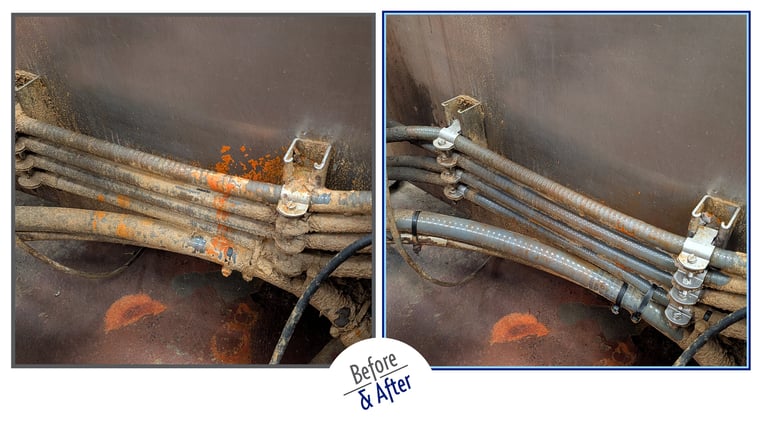
Dry ice blasting is a proven effective method for industrial cleaning that uses kinetic energy, cold, and rapid gas expansion to effectively remove contaminants without inducing damage or secondary waste to clean up. Cleaning machines and equipment with dry ice can be done in-place and online, significantly reducing downtime.
Need to clean large machines, equipment, or surfaces in-place, online, and without disassembly or significant downtime? Dry ice blasting can get it done.
Contact Cold Jet to choose the right dry ice blasting solution for you!
