 English

What Is the Most Durable Dry Ice Blaster for Harsh Industrial Environments?
The Quick Answer: The durability of an industrial dry ice blaster is determined by how well it withstands continuous cryogenic thermal shock (-109.3°F / -78.5°C) and sustained compressed air pressure (up to 250 PSI on high-pressure models).
The Cold Jet Aero2® ULTRA Series (Aero2 PCS ULTRA and Aero2 PLT ULTRA) is engineered as the most durable due to its anodized aluminum chassis, stainless steel components, IP67-rated sealed applicators, and pulse-free feeding system. For rough, all-weather job sites, Cold Jet’s analog-control machines, including the Aero 40FP, Aero 80FP, Elite 20, and IceRocket PLT, carry fewer sensitive electronics and hold up well in field conditions. With routine maintenance, Cold Jet dry ice blasters regularly remain in service for multiple years.
A dry ice blaster’s value is measured not only by its cleaning power, but by how well it withstands environmental and mechanical stress over its service life. Build quality determines both how well a dry ice blaster performs and how long it performs without issue. When something does go wrong, OEM support for servicing and replacement parts is just as important to durability. Most dry ice blasters can handle dings, scratches, and bumps, but not all of them withstand the ultra-cold temperatures inside the machine without wearing out parts prematurely.
This article explains what makes a dry ice blasting machine durable inside and out, and how Cold Jet dry ice blasters are built to last.
What Features Make a Dry Ice Blaster Durable?
Surviving drops, transport, and rough terrain is part of durability, but the bigger factors are internal. Two operational stressors affect the long-term durability of any dry ice blasting machine:
- Cryogenic Exposure and Thermal Shock: Every component that touches or transfers dry ice is exposed to -109.3°F (-78.5°C) during every blasting session, so it must resist thermal shock-induced cracking, splitting, or embrittlement over years of use.
- High-Pressure Airflow and Mechanical Wear: Dry ice blasting runs on compressed air, so internal components that are subjected to the constant air volume and air pressure running through the machine must be built from high-tolerance materials to resist long-term wear.
Every part of a dry ice blasting machine is affected by these stressors, which is why material selection determines machine function and part longevity.
The following components and support factors determine how long a dry ice blaster lasts:
- Outer Frame and Chassis: The frame and side panels are the barrier between the machine’s internal components and the work environment, so they must protect against impacts, falls, chemical exposure, weather, and moisture. Materials such as tool-grade aluminum, heavy-gauge stainless steel, and high-tolerance polymers provide that protection without adding excessive weight.
- Motors: Motors endure some of the highest stresses in the machine, from both extreme temperature differentials and mechanical friction. Long-lasting motors are built with high-quality metal alloys and protected components to resist wear and keep running in cold conditions.
- Hopper: The hopper holds the dry ice supply during blasting and must be insulated to keep cold, dry air inside and heat and humidity outside, preventing ice bridging and clumping. Hopper construction requires cold-resistant metals and sealants that resist fatigue from repeated expansion and contraction.
- Air system: Internal piping must route compressed air at pressures up to 250 PSI through long blasting sessions without failure. Valves, O-rings, gaskets, and isolation breaks fatigue under sub-zero temperatures and constant airflow, so they must be built to handle sustained stress.
- Dry ice feeding system: Feeder components such as dosing discs, rotors, gears, and seals are among the most common failure points in dry ice blasters, succumbing to freezing, ice bridging, friction, and air pressure. Feeder components built to withstand cryogenic temperatures and constant stress extend the life of the machine and the interval between part replacements.
- Electronics and wiring (if applicable): On dry ice blasters with digital displays and electronic controls, wiring and circuitry must be protected from cold and moisture. Cold-rated cable jacketing and electronics partitioned away from cryogenic components are critical design elements.
- Wheels and casters: A dry ice blaster has to follow the operator into the work environment, whether that means tight spaces or uneven terrain. Large rubber tires and free-moving casters that resist rust and sticking keep the machine mobile.
- Applicators: The applicator must withstand high air pressure and constant cryogenic exposure, both internally and at the nozzle. Nozzles must resist the wear of accelerating dry ice particles at high pressure across full shifts.
- Hoses and connection points: Blast hoses take some of the most stress of any component, withstanding temperature swings, high air pressure, and constant movement and coiling. Quick-disconnect couplings also wear over time, so their construction matters for preventing leaks and pressure loss.
- Spare part availability: Replacing worn parts promptly extends the life of the machine and prevents secondary wear on components that compensate for a failing part. Access to a well-stocked spare parts inventory keeps a worn part from forcing the premature purchase of a new machine.
- Technical support availability: Access to technicians who can troubleshoot issues quickly prevents small problems from becoming expensive repairs or replacements.
Metal vs. Plastic: Which Materials Are Better for Durability?
Budget dry ice blasters often cut costs in construction materials, substituting thinner metals and hardened plastics to reduce build cost and weight. These decisions lead to structural issues and parts that wear out earlier than expected, adding to the total cost of ownership.
The Most Durable Dry Ice Blasters by Cold Jet
Every dry ice blaster in the Cold Jet lineup is built for durability and serviceability, using materials selected to withstand cryogenic and high-pressure operation. As the OEM, Cold Jet backs each machine with a spare parts inventory and a global network of trained technicians. Service, parts, and warranty coverage are the same across the lineup and are detailed after the product summaries below.
Cold Jet Aero2 PCS ULTRA and Aero2 PLT ULTRA
The two Aero2 ULTRA Series dry ice blasters, the Aero2 PCS ULTRA and Aero2 PLT ULTRA, are the most robust machines in the Cold Jet lineup. These machines are built with alloys and materials that are designed for the harshest industrial conditions while keeping internal components protected.
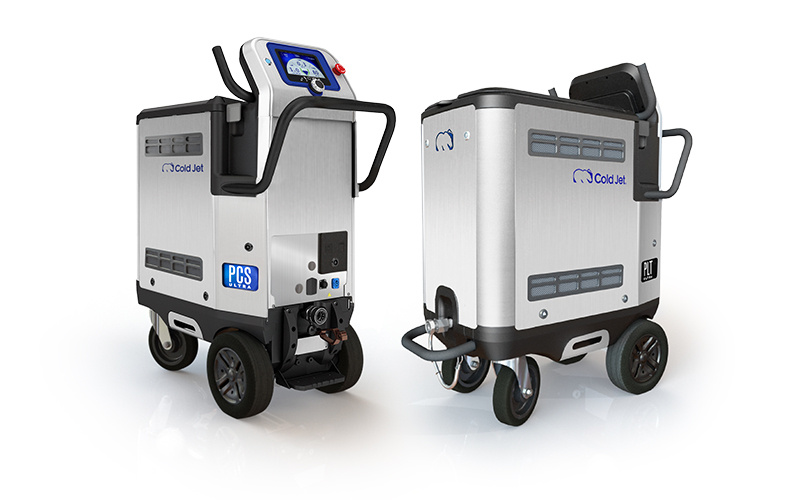
Durability:
- Tool-Grade Aluminum Alloy Frame and Chassis: Coated tool-grade aluminum alloy, stainless steel, and high-tolerance polymer components provide impact resistance at a lower overall weight for better mobility
- Ultra-Cold Temperature Motors: Motors, gearboxes, wiring, and cabling are rated for ultra-cold operation and keep working through long blasting cycles
- Proprietary Control Firmware and Motor Drivers: Cold Jet-specific firmware and motor drivers draw optimal power from the motors, reducing strain and extending service life
- IP67-Rated Applicators: Patented Cold Jet applicators withstand high pressure at ultra-low temperatures, with IP67-rated components and watertight connectors for moisture protection
- Insulated Hopper: Both units have a 60 lb. insulated hopper integrated with the patented SureFlow feeder system to maintain a consistent flow of dry ice and minimize sublimation
- Multi-Layered Blast Hoses: Reinforced, flexible blast hoses are available in multiple lengths with layered protection for the dry ice air stream and the operator
- Proprietary Cold Jet Nozzles: Nozzles designed and manufactured in-house by Cold Jet use anodized aluminum and polymer-coated stainless steel for extended service life in addition to urethane and polymer nozzles
- Core Contamination Control (PCS ULTRA): An internal shield keeps dust and debris away from core components, reducing routine maintenance
Serviceability:
- QR Code Troubleshooting: When a fault stops the machine, operators scan a QR code on the HMI to pull up fault-specific troubleshooting and submit a service ticket that automatically includes the serial number, firmware version, error codes, and machine hours
Cold Jet Aero 40FP and Aero 80FP
The Aero 40FP and Aero 80FP are full-pressure dry ice blasters built for industrial environments that involve bumps, falls, chemical exposure, weather, and daily wear. Built with heavy-gauge steel and mounted on large wheels, these machines are designed to move and clean anywhere in a plant.

Durability:
- Heavy-Duty Steel Frame and Chassis: A heavy-gauge steel frame provides impact resistance and protects internal components from the elements
- Mobility: Large flat-free tires, ergonomic push/pull handles, and a 360-degree turning radius for tight spaces and uneven terrain
- Patented Radial Feeding System: Aerodynamic loading reduces wear on the rotor and pads, extending machine life
- Analog Controls: Blast pressure and dry ice feed rate adjust with simple analog controls and an onboard pressure regulator
- Insulated Dry Ice Hopper: 40 lb. (Aero 40FP) or 80 lb. (Aero 80FP) insulated hopper minimizes sublimation between blasting cycles
Serviceability:
- Easy-Off Side Panels: Tool-free, quick-release panels expose the motor compartment and feeder system for on-the-spot inspection
Cold Jet i3 MicroClean 2
Built for low-CFM and delicate cleaning applications, the i3 MicroClean 2 brings digital controls and Aero2 ULTRA design elements to a compact machine. Its stainless steel and aluminum construction keeps weight down while protecting internal components in industrial environments.
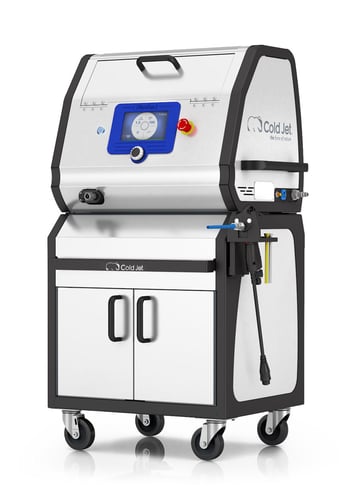
Durability:
- Stainless Steel Body on Aluminum Frame: A stainless-steel body on a rigid aluminum frame provides durability at a fraction of the weight of a full-size blaster
- Flexible Blast Hoses: Redesigned blast hoses in 3/8-inch or 1/2-inch diameters add flexibility and durability under daily use
Serviceability:
- Proactive Service Alerts: Usage data collected through Cold Jet CONNECT enables proactive service before a fault takes the machine down
Cold Jet i3 MicroClean
The original i3 MicroClean was designed for delicate cleaning work and is built to the same durability standards as the rest of the Cold Jet lineup, with a welded steel frame protecting its internal components.
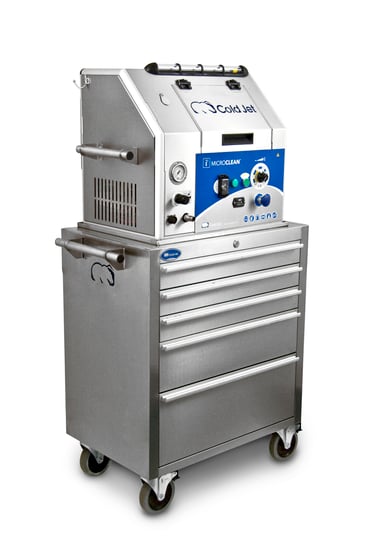
Durability:
- Welded Steel Frame: Provides structural rigidity and long service life in daily production use
- Stainless Steel Rotor: Stands up to continuous contact with dry ice and resists corrosion
- Burst-Proof Blast Hose: A protective cover stands up to daily handling and dragging across work surfaces, with Urethane or flexible silicone options available
- Moisture-Managed Pneumatics: Pneumatic circuitry limits pressure loss and reduces moisture buildup inside the machine
Serviceability:
- Removable Panel Access: Removable panels provide access for routine maintenance without specialized tools
Cold Jet Elite 20
The Elite 20 is a professional-grade, entry-level dry ice blaster that handles a wide range of applications in a compact, stainless-steel package.
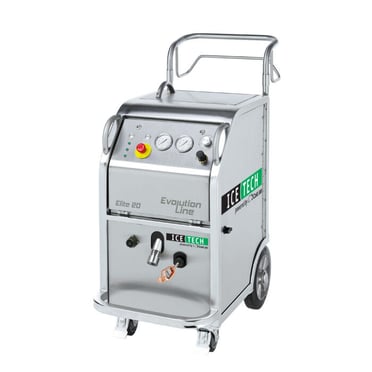
Durability:
- Stainless Steel Frame: A heavy-duty stainless-steel frame provides impact, chemical, and corrosion resistance in shop and small industrial environments
- Analog Controls: Blast pressure and dry ice feed rate adjust with simple analog controls
- Insulated Dry Ice Hopper: A 44 lbs. insulated hopper minimizes sublimation during longer sessions
Serviceability:
- Quick-Change Dosing Disc: Dosing discs swap out in minutes, reducing maintenance downtime
- Tool-Free Side Panels: Quick-release side panels open without tools for access to the motor and internals during inspection and maintenance
Cold Jet IceRocket PLT
The IceRocket PLT is Cold Jet’s entry-level dry ice blaster, delivering professional-grade performance in a compact stainless-steel frame. Its size and build make it highly mobile and resistant to impacts, falls, and the elements.
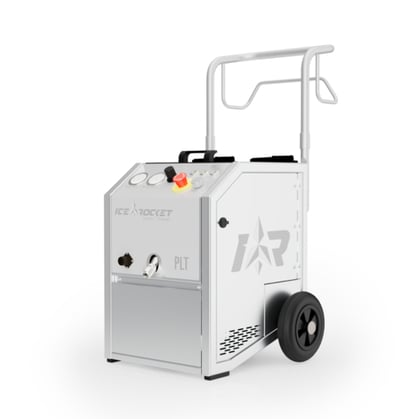
Durability:
- Stainless Steel Frame: A heavy-duty stainless-steel frame provides impact resistance in shop and small industrial environments
- Mobility: Heavy-duty wheels for moving between shop and industrial work areas
- Analog Controls: Operators adjust blast pressure and feed rate directly, with no digital menus to navigate
Serviceability:
- Easy-Access Design: A simple mechanical layout allows quick inspection of the internal 3/4-inch piping and pneumatics
Cold Jet Service, Parts, and Warranty Coverage
Every Cold Jet dry ice blaster is backed by the same OEM support network:
- Global Service Network: 16 service centers in 11 countries, with technical support available 24/7, 365 days a year
- Genuine OEM Parts: Cold Jet designs and manufactures its own parts and maintains a spare parts inventory, available through direct global distribution and online parts manuals
- Cold Jet CONNECT®: On CONNECT-enabled machines, Cold Jet’s Industry 4.0 platform tracks machine utilization, dry ice usage, feed rates, and blasting time, and provides remote diagnostics and support from certified Cold Jet technicians without waiting for a site visit
- Tiered Service Agreements: CONNECT Care provides an extended warranty, parts discounts, and priority remote assistance; CONNECT Enterprise adds onsite preventative maintenance, training, and a spare parts kit
- Warranty: 13-month comprehensive coverage for new machines and 90-day coverage for Certified Pre-Owned (CPO) units
- CE and UL Compliant: Certain Cold Jet blasting machines are built to satisfy certain EU Machinery Directives (CE) and UL requirements, including the Aero2 PCS ULTRA, Aero 40FP, Aero 80FP, Elite 20, and i3 MicroClean 2
Frequently Asked Questions (FAQ)
What makes a dry ice blaster durable?
Dry ice blaster durability comes down to two things: the materials the machine is built from, and the support available to maintain it. Durable machines use high-tolerance materials such as heavy-gauge stainless steel, tool-grade aluminum alloys, and stress-tolerant polymers that resist cryogenic temperatures, friction, and mechanical stress. OEM support for maintenance, troubleshooting, and part replacement keeps the machine in service over the long term.
Cold Jet builds its dry ice blasters from these materials and supports every customer with a spare parts inventory and a global network of technicians available 24/7.
What is the expected operating lifespan of an industrial dry ice blaster?
With preventative maintenance, industrial dry ice blasters routinely operate for 10+ years. Because dry ice sublimates on impact and leaves no abrasive media inside the machine, internal components see far less wear than those in sand, bead, or slurry blasters. Longevity depends on:
- Replacing consumable components such as seals, rotor plates, and hose strain reliefs before air leaks or misalignment damage primary assemblies
- Performing scheduled preventative maintenance inspections
- Using machine diagnostics to identify issues in real time on CONNECT-enabled machines
Cold Jet dry ice blasters that follow this maintenance schedule regularly exceed 10 years of service.
Which dry ice blaster components require routine replacement?
Even on a robust machine, consumable parts exposed to constant friction, vibration, and thermal cycling require routine replacement:
- Dosing Rotor and Airlock Seals: Seals that isolate compressed air from the hopper gradually wear, leading to pressure loss
- Blast Hose Liners: High-velocity dry ice pellets gradually wear the interior hose wall
- Nozzles: Constant particle impact erodes the throat profile of a converging-diverging nozzle over hundreds of hours of use
- Pneumatic O-Rings and Gaskets: Repeated expansion and contraction from sub-zero air causes O-rings to lose elasticity and crack
Cold Jet stocks replacement parts for its dry ice blasters and provides service through its global network.
Are all-pneumatic dry ice blasters more durable than electric or digitally controlled units?
All-pneumatic dry ice blasters can be more robust in harsh environments, but they give up the precision and efficiency of digitally controlled machines. Because they run entirely on compressed air, there are no electrical components to short, corrode, or break when dropped.
Digitally controlled units use microprocessors and electric motors to deliver precise dosing, pulse-free dry ice delivery, and variable particle control on Aero2 PCS ULTRA machines. Their electronics are housed in sealed enclosures, but they can be more vulnerable to physical shock and power surges in field environments than all-pneumatic systems.
Cold Jet’s digitally controlled machines are designed to address these vulnerabilities: critical electronic components are partitioned away from cryogenic components and built with cold-rated cables and wiring to hold up in harsh work environments.
Final Takeaway: Durable Dry Ice Blasters Combine Strong Materials with OEM Support
Need help choosing the right dry ice blaster for your application? Contact Cold Jet to talk with a member of our team.
